Sweet Tea for Two
People came to Briar Glen chasing the mountains—their blue ridges, their clean air, their promise of quiet. They stayed because, sooner or later, somebody remembered their name.
Tom Walker rolled into town on a Friday with Wyoming plates, a dusty pickup, and enough manners to make every grandmother in Briar Glen curious about whether he was eating properly. By Monday, Steve had called him neighbor. By Tuesday, Tammy knew he preferred light ice. By the following Sunday, he belonged.
Nobody could explain how that happened. Some towns made you earn your place. Briar Glen simply pulled up another chair.
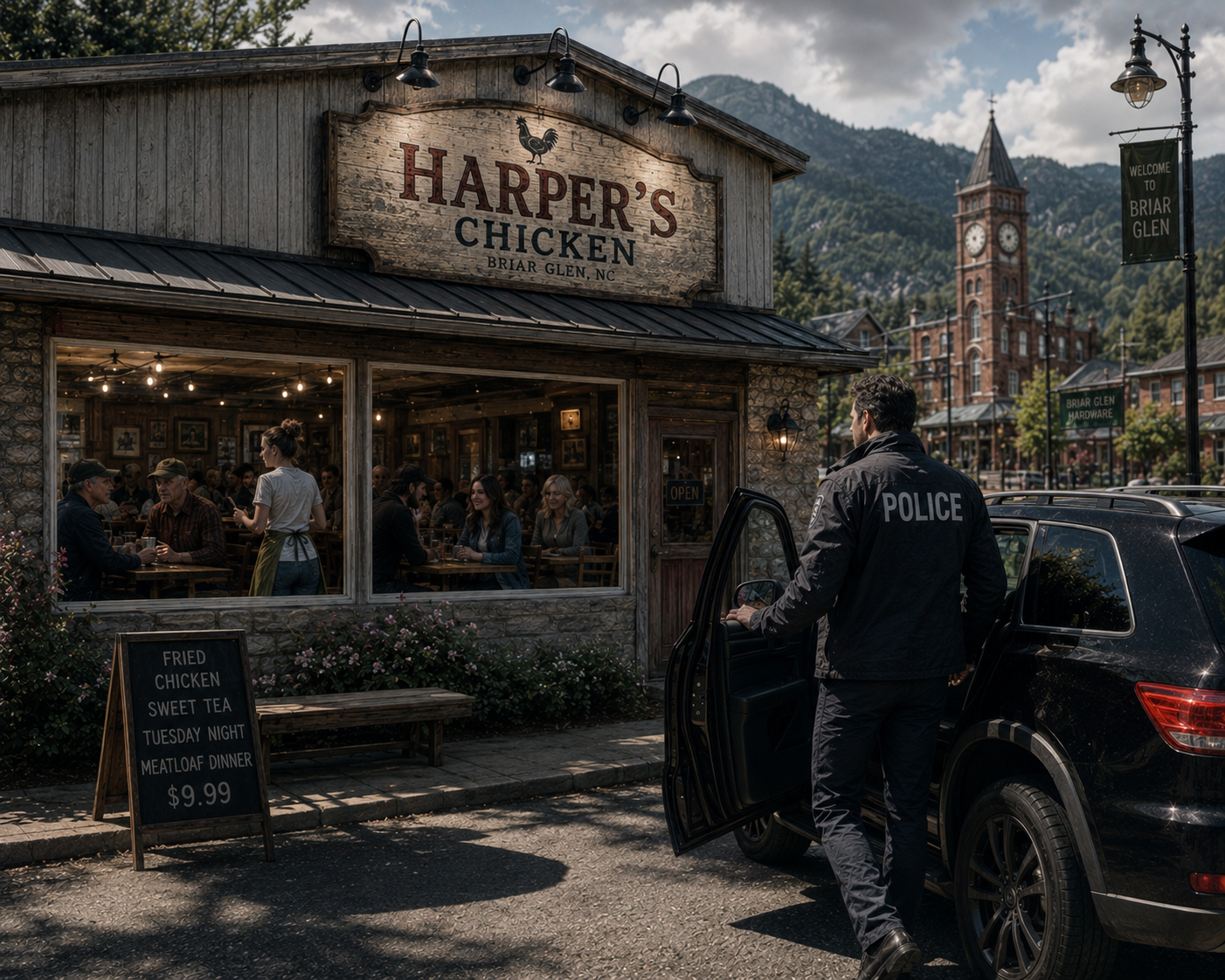
If you wanted the best fried chicken in the county, there were probably better places. Paul claimed there were three. Steve claimed Paul was full of shit. But if you wanted to know what was happening in Briar Glen, you went to Harper’s Chicken.
On Thursday afternoons, Steve and Paul held court at the corner table beneath the rooster clock, arguing with the confidence of men who had been wrong in public for decades.
“You can’t even remember where you parked your truck,” Paul said.
Steve pointed across the dining room toward Tammy, who was carrying four glasses of sweet tea against one hip and a look that dared anybody to slow her down.
“Tammy moved it.”
Tammy did not break stride. “Honey, if I could move that truck, I’d move it out of town.”
She set a basket of chicken tenders in front of Steve. “You want ranch with your outrage?”
Steve considered this. “Yeah.”
“Thought so.”
That was how most arguments ended at Harper’s: not settled, just fed. They argued about weather, fishing, football, politics, and whether tomatoes had any business being in chicken salad.
Nobody ever won because nobody really wanted to. Tammy kept the sweet tea coming, Ms. Bobbi worked crossword puzzles near the register, and half the town pretended not to listen while remembering every word.
Tom always took the booth beside the front window. Every Thursday, he ordered one basket of chicken tenders and two sweet teas.
The first time he did it, Tammy glanced toward the empty seat across from him.
“You expecting somebody?”
“No, ma’am.”
She looked at the second glass, then back at him. “You know I’m charging you for both.”
“That seems fair.”
“Well, all right, then.”
People were allowed to have routines. Harper’s was built on them.
Two glasses of sweet tea sit in a quiet restaurant booth, symbolizing love, memory, and devotion in “Sweet Tea for Two.”
Julianna first noticed Tom because he never seemed to be in a hurry. He held doors without turning around to see who walked through. He returned grocery carts from the far end of parking lots. He picked up litter that did not belong to him and carried heavy things without announcing that he had done it. It was the kind of kindness that disappeared the moment someone pointed it out, and Julianna, who painted things for a living, found herself watching the space it left behind.
They properly met beside Joseph Creek. Julianna sat near the bank with a watercolor pad balanced across her knees. She was trying to paint the mill’s reflection in the water, though the creek kept breaking it apart before she could decide what color it was supposed to be.
Tom stood several yards downstream, skipping flat stones.
“You’re not from around here,” she said.
“No, ma’am.”
She glanced toward his pickup beneath the trees. “Wyoming?”
He nodded. “Casper.”
“That’s a long way from Briar Glen.”
“Sure is.”
He sent another stone across the creek. It jumped twice, thought better of it, and sank.
“But it’s been good to me,” he added.
The town folded Tom into itself the way mountain fog settled into the valley. He helped Steve repair a fence, although Steve spent most of the afternoon explaining how he would have done it himself if his back had not been “acting like a contrary son of a bitch.”
He carried Tammy’s groceries when her knee began bothering her. When she told him she could manage, he said, “I know,” and kept walking.
He also pulled Paul’s truck from a muddy shoulder after Paul took a curve too quickly in the rain. Paul reached for his wallet once the truck was free. Tom shook his head.
“Don’t worry about it.”
Paul put the money away. “Well, shit.”
“What?”
“Now I’ve got to be nice to you.”
Steve, who had arrived solely to supervise, leaned against his truck. “You’ll never pull that off.”
Nobody asked where Tom had learned to do those things. Some people arrived already knowing how to belong.
The truth about Wyoming came slowly, the way most important things did at Harper’s—not in one confession, but in fragments left behind with coffee cups and folded napkins. Tom had not come to Briar Glen for the mountains after all. He had come because Asheville had doctors with new words for old heartbreak, and because one of those doctors had said the phrase clinical trial with enough hope in it that Tom packed up a life in Wyoming before he had time to be afraid.
Tom’s wife, Emily, came into their understanding the same way: gradually, then all at once. She had once been the louder of the two of them. That was what Tom told Tammy one slow afternoon, though he said it like a man offering a fact, not asking for pity. She had loved road maps, bluegrass festivals, diner coffee, and arguing with him about whether sweet tea needed lemon. She had called every stray dog sir and every baby darlin’, and she had never met a waitress without learning her name.
Then she began losing small things. A recipe she had made for twenty years. The road back from the grocery store. The name of a neighbor’s child. At first, people called it stress, or exhaustion, or one of those strange spells that would surely pass. Then the doctors called it early-onset Alzheimer’s, and the word early seemed cruelest of all. Tom and Emily were barely fifty, young enough that people lowered their voices when they heard the diagnosis and then looked away because no one knew what to do with grief that arrived before its time.
The trial near Asheville had opened like a door in a house they thought had gone dark. So Tom sold what he could, stored what he could not, and drove Emily east through states she forgot as soon as they crossed them. Now she lived in an assisted-care place tucked off a road lined with rhododendron, and Tom visited nearly every other day. Some days she knew him before he reached her chair. Some days she asked whether he had seen her husband.
Harper’s learned the rest by watching what Tom did not say. The second sweet tea remained on the table because, years ago, Emily had said she liked it best after the ice started melting. So every Thursday, Tom ordered one for himself and one for her, and he let hers sit across from him until the glass sweated a ring onto the table.
So when Tom finally brought Emily to Harper’s Chicken, Tammy nearly dropped a tray of biscuits. It was a Thursday, late enough that the lunch rush had thinned but early enough that Steve and Paul still occupied their usual table like two old courthouse pigeons. Ms. Bobbi was near the register, filling in crossword squares with a seriousness that suggested the fate of the county depended on six letters for “lament.”
Tom came in first, holding the door with one hand and reaching back with the other. A woman stepped through slowly beside him. She was small in a blue cardigan, her silver-brown hair pinned at the nape of her neck, one hand tucked into the crook of Tom’s arm as though the room had tilted and he was the thing she trusted not to move.
For once, nobody said anything.
Tammy looked at Tom. Tom gave the smallest nod, the kind that asked for help without wanting to admit it. Tammy understood immediately, because waitresses knew more about human trouble than preachers and doctors combined.
“Well, look at you,” Tammy said, bright as morning. “You must be Emily.”
Emily smiled politely. “I am.”
“Good. I’ve been keeping your seat from getting too proud of itself.”
Emily laughed at that, a soft surprised sound, and Tom looked down at her with such naked relief that Julianna, sitting alone near the window with a sketchbook closed beneath her hands, had to turn her face toward the parking lot.
Tammy led them to Tom’s booth. She did not ask what they wanted. She returned with two sweet teas, one with light ice and one that had been sitting long enough for the cubes to soften at the edges.
Emily wrapped both hands around the glass and took a sip. Her eyes closed for a second.
“That’s better,” she said. “When the ice starts melting.”
Tom’s mouth moved like he meant to answer, but nothing came out. He only nodded and unfolded her napkin across her lap with a care so practiced it seemed older than sorrow.
Steve leaned toward Paul and opened his mouth.
Paul pointed a biscuit at him. “Don’t.”
Steve shut his mouth.
It was the quietest anyone had ever seen him be.
Emily looked around Harper’s with careful interest, as though each thing in the room needed permission before becoming familiar. She studied the rooster clock above the counter, the handwritten pie list, the photographs of Little League teams from years when all the boys wore the same crooked grin.
“This is a nice place,” she said.
“It is,” Tom said.
“Do we come here often?”
Tom’s hand paused on the paper sleeve around his straw. “I do.”
Emily turned toward him, studying his face with a tenderness that arrived before recognition and vanished just as quickly.
“Have you seen my husband?” she asked.
The whole room seemed to hear it, though nobody looked over.
Tom breathed in once through his nose. Then he smiled, gentle and ruined.
“I’ll keep an eye out for him,” he said.
Emily seemed satisfied with that. She patted his hand, not like a wife thanking her husband, but like a kind stranger grateful for directions.
Julianna lowered her eyes to her sketchbook. She had thought sorrow had a shape, that it announced itself in tears or empty rooms or black clothes. But this was different. This was a man sitting across from the woman he loved while she waited for him to arrive.
Tammy came by with a basket of chicken tenders and set it down like an offering.
“Best in the county,” she said.
Steve made a strangled noise.
Paul kicked him under the table.
“Best in the county,” Steve said quickly.
Emily laughed again, and that was enough. For the next hour, Briar Glen behaved itself. Tammy kept Emily’s tea at the proper stage of melting. Ms. Bobbi brought over a crossword and asked Emily if she knew a five-letter word for “home.” Paul told one story and managed not to cuss until the very end. Steve offered to show Tom a shortcut to Asheville that everybody knew was longer, but Tom thanked him anyway.
When Emily grew tired, the change came softly. Her shoulders folded inward. Her smile thinned. Tom saw it before anyone else did.
“We ought to get you back,” he said.
Emily nodded, then looked across the table at the second glass. “Don’t forget yours.”
Tom looked at the tea, then at her. “I won’t.”
At the register, Tammy pushed his money back across the counter.
“Not today,” she said.
“Tammy.”
“I said not today.”
Behind him, Steve cleared his throat. “Gas ain’t cheap to Asheville.”
Paul stared at him. “That was almost decent.”
“Don’t get used to it.”
Tom stood very still, one hand resting at Emily’s back. His face had the startled look of a man who had spent so long carrying something alone that he no longer knew what to do when other hands reached for the weight.
Julianna rose before she could talk herself out of it. She crossed the room and held open the door.
Emily paused beside her. “Are you the artist?”
Julianna’s breath caught. “Sometimes.”
Emily smiled as if this pleased her. “You should paint this place.”
Then she let Tom guide her into the afternoon.
Julianna stood in the doorway long after the pickup pulled away, watching the mountains gather blue around the road to Asheville.
She was still there when Tom came back forty minutes later.
He had driven Emily back to the facility and returned with the empty look of a man who had done something ordinary and impossible in the same afternoon. He stood beside the pickup for a moment, one hand resting on the door, looking toward Harper’s but not quite ready to go in.
Julianna stepped out onto the sidewalk before she could decide whether it was kind or foolish.
“You don’t have to come back in,” she said.
Tom looked at her, then past her to the windows glowing warm over the checkered curtains. “If I don’t, Tammy will send somebody after me.”
“Probably Steve.”
“God help me.”
The laugh that passed between them was small and tired, but it was there. Julianna held on to it longer than she should have.
They walked without saying much, away from Harper’s and down toward Joseph Creek, where the late sun broke itself across the water. Julianna carried her sketchbook against her chest. Tom kept his hands in his pockets, shoulders rounded as though bracing against weather that had not arrived.
At the bank, he stopped near the place where she had first seen him skipping stones.
“She had a good day,” Julianna said.
Tom picked up a flat stone, turned it over once, and let it fall. “Yeah.”
“I’m glad she came.”
“Me too.” He looked down at the creek. “I almost didn’t bring her. Thought maybe it was selfish.”
“Wanting people to know her isn’t selfish.”
Tom’s jaw shifted. “Some days I don’t know what’s for her and what’s for me.”
Julianna did not answer too quickly. The creek moved around stones and roots and fallen leaves, making room the way water did, without calling it mercy.
“Maybe it can be both,” she said.
Tom looked at her then, really looked, and Julianna felt the quiet danger of being seen by a man who had spent years watching someone disappear. She wished she could step closer. She wished she had not wished it.
“I miss her,” he said. “That’s the part nobody tells you how to say. I miss her while she’s sitting right in front of me.”
The words settled between them. Julianna’s throat tightened, not only for Emily, and not only for Tom, but for the small, shameful part of herself that had been glad when he came into Harper’s alone.
“I don’t know what to do with that,” he said.
“You don’t have to do anything with it today.”
He nodded, but his eyes stayed on hers. There was gratitude there, and grief, and something neither of them was ready to name.
Julianna looked down at the sketchbook in her arms. “Emily told me to paint Harper’s.”
For the first time since he had returned, Tom smiled like the expression had found him by accident. “She always did have good taste.”
“I might do it,” Julianna said.
“You should.”
Across the creek, the old mill caught the last of the light in its broken windows, not watching anymore, Julianna thought, but remembering. For once, that did not seem like a haunting. It seemed like a kindness, and she wondered whether a painting could do the same thing: hold a place steady for someone who could not.
Julianna began the painting the next morning.
She set her easel in the corner booth before Harper’s opened, while Tammy wiped down tables and pretended not to watch. The first wash of color was nothing more than sunlight through the front window, pale gold across chipped tabletops and red vinyl seats. Then came the counter, the rooster clock, the pie list, Ms. Bobbi’s crossword pencil lying beside the register like it had simply paused to think.
She did not paint Tom at first. She painted around him—the empty booth, the two glasses, one clear and sharp with ice, the other softened at the edges, beads of water sliding down its side. She painted the wet ring it left on the table. She painted the chair across from him not as empty, exactly, but waiting.
By noon, everyone had an opinion.
“Needs more chicken,” Steve said.
“It’s not a menu,” Paul said.
“Everything needs more chicken.”
Tammy leaned over Julianna’s shoulder. “Don’t listen to him. If he had his way, the Mona Lisa would be holding a drumstick.”
“She’d be smiling bigger,” Steve said.
For three days, Julianna returned to Harper’s before opening and stayed after closing. The town came and went around her. Someone brought extra lamps when the afternoon light faded. Ms. Bobbi supplied a five-letter word for “devotion” and then, dissatisfied with every answer, wrote Tom in the margin. Tammy kept a towel under the painting table so no one would track grease near the canvas.
Tom did not come in while she worked. Tammy said he was in Asheville with Emily. She said it the way people in Briar Glen had begun saying it, softly and without asking for more.
On the fourth Thursday, Harper’s was louder than usual and trying very hard not to be. Paul had worn a clean shirt. Steve had combed his hair badly. Ms. Bobbi sat by the register with her crossword closed. The painting stood covered beside Tom’s booth beneath a sheet Tammy claimed was “not one of the good ones,” though everyone knew she had ironed it.
Tom arrived alone.
He paused in the doorway, taking in the room, the covered canvas, the people who suddenly became fascinated by menus they already knew by heart.
Julianna stood beside the covered painting with both hands folded in front of her. She had rehearsed a speech and lost every word of it the moment Tom looked at her.
“Emily told me to paint this place,” she said.
Tom glanced toward the booth, where Tammy had already set two sweet teas. His hand went still at his side.
“So I did,” Julianna said.
She pulled the sheet away.
For a moment, no one spoke.
The painting was Harper’s, but not exactly as it looked. It was warmer, gentler, as if the room had been holding its breath and finally let it out. There was the front window with mountain light coming through, the booth beside it, the two glasses of sweet tea catching gold at their rims. One chair was pulled back slightly, as if someone had just stood or was just about to sit down. In the far corner, Steve and Paul were only suggestions of shape and argument. Near the register, Ms. Bobbi’s crossword lay open to a blank square.
And on the table, beside the second tea, Julianna had painted a small folded napkin with two words written across it in Tammy’s slanted hand.
For Emily.
Tom looked at it for a long time. His eyes moved over the glasses, the chair, the napkin, the impossible kindness of a room that had made space for a woman even when she was not there to fill it.
“That’s hers,” Tammy said, quieter now. “The booth, I mean. Whenever she wants it.”
Tom pressed his thumb and forefinger to his eyes. When he lowered his hand, he was smiling, though it did not hide anything.
“She would’ve liked that,” he said.
“She does,” Julianna said before she could stop herself.
Tom looked at her.
Julianna’s face warmed, but she did not take it back. “She does,” she said again. “Even if not all of her can say so every day.”
Paul cleared his throat. “Well, hell. Somebody hang the damn thing before Steve tries to improve it.”
“Needs more chicken,” Steve said, but softly this time.
They hung the painting beside the register, above Ms. Bobbi’s table, where everyone who came through the door could see it before deciding whether to pretend they had not. Tammy stood beneath it with her hands on her hips.
“It needs a title,” she said.
Julianna looked at Tom.
He looked at the two glasses glowing in the painted light.
“Sweet Tea for Two,” he said.
No one argued with him.
After that, the second tea was never strange again. Tammy brought it without asking. Steve stopped making jokes about it, which Paul said was proof that miracles still occurred in small doses. Ms. Bobbi eventually found her five-letter word for home, though she refused to tell anyone what it was.
And every Thursday, whether Emily came or did not, whether she knew Tom or asked him kindly to watch for her husband, Harper’s kept the booth by the window ready. Tom promised to bring her back on the next good day. One tea with light ice. One left to soften.
Because in Briar Glen, people still came for the mountains.
But they stayed because somebody remembered their name.
(Stories From Briar Glen is an ongoing series set in the world of Briar Glen. Some characters and locations may appear in future novels.)